Welcome to the Bruns Lab – Sustainable Functional Polymers

We are a polymer chemistry research group led by Prof. Nico Bruns at the Department of Chemistry and the Centre for Synthetic Biology of the Technical University of Darmstadt in Germany.

Our research in the realm of Sustainable Functional Polymers wisely combines synthetic polymer chemistry with the engineering of proteins and enzymes. Via this approach, some of the best aspects of two different domains of macromolecular chemistry are combined in order to exploit the catalytic power of enzymes, to create novel nanosystems and to develop materials with unprecedented new functions. Four lines of research illustrate our strategy:

  • Biocatalytic Atom Transfer Radical Polymerizations (bioATRP)
  • Artificial cells and polymer-enhanced synthetic biology
  • Engineered living materials
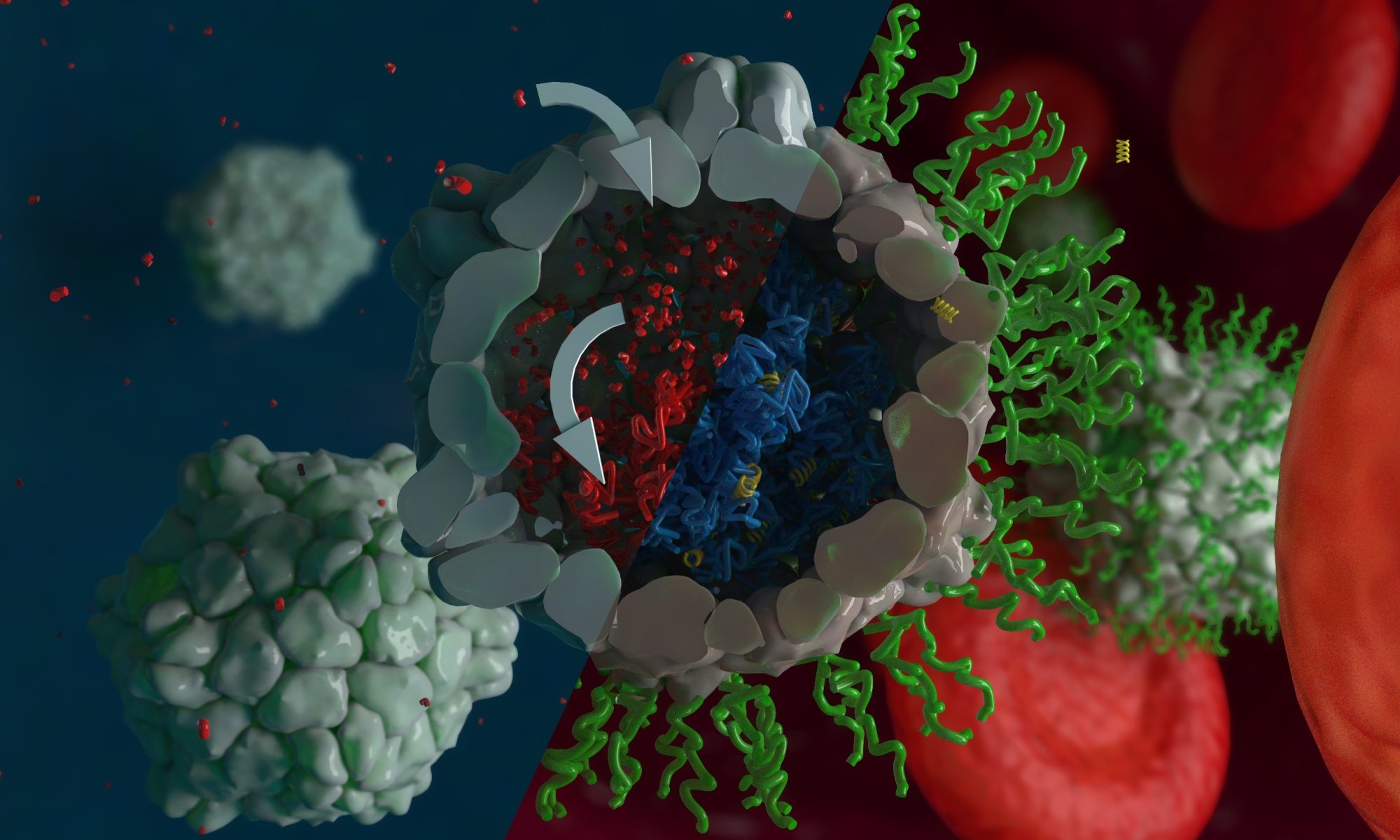
  • Block copolymer vesicles (polymersomes) and protein cages as nanoreactors and nanocapsules
  • Bio-inspired materials
  • Polymerization-amplified malaria diagnostics
The Team

Our interdisciplany and multinational research team consists of PhD students, postdocs, and undergraduate students. Their background ranges from polymer chemistry, to organic chemistry, bioinorganic chemistry, enzymology, biotechnology, protein engineering, and material sciences.

Current group memebers come from Germany, UK, Italy, Australia, Turkey, Russia, Iran, India and China.

Selected Publications

  • Belluati, A.; Jimaja, S.; Chadwick, R. J.; Glynn, C.; Chami, M.; Happel, D.; Guo, C.; Kolmar, H.; Bruns, N., Artificial cell synthesis using biocatalytic polymerization-induced self-assembly. Nat. Chem. 2024, 16, 564-574. DOI: 10.1038/s41557-023-01391-y
  • Sproncken, C. C. M.; Liu, P.; Monney, J.; Fall, W. S.; Pierucci, C.; Scholten, P. B. V.; Van Bueren, B.; Penedo, M.; Fantner, G. E.; Wensink, H. H.; et al. Large-area, self-healing block copolymer membranes for energy conversion. Nature 2024. DOI: 10.1038/s41586-024-07481-2.
  • Liu, P.; Jimaja, S.; Immel, S.; Thomas, C.; Mayer, M.; Weder, C.; Bruns, N. Mechanically triggered on-demand degradation of polymers synthesized by radical polymerizations. Nat. Chem. 2024. DOI: 10.1038/s41557-024-01508-x
  • Rifaie-Graham, O.; Galensowske, N. F. B.; Dean, C.; Pollard, J.; Balog, S.; Gouveia, M. G.; Chami, M.; Vian, A.; Amstad, E.; Lattuada, M.; Bruns, N., Shear stress‐responsive polymersome nanoreactors inspired by the marine bioluminescence of dinoflagellates. Angew. Chem. Int. Ed. 2021, 60, 904-909. Link
  • Rifaie-Graham, O.; Pollard, J.; Raccio, S.; Balog, S.; Rusch, S.; Hernández-Castañeda, M. A.; Mantel, P.-Y.; Beck, H.-P.; Bruns, N., Hemozoin-catalyzed precipitation polymerization as an assay for malaria diagnosis. Nat. Commun. 2019, 10, 1369. Link
  • Rifaie-Graham, O.; Ulrich, S.; Galensowske, N. F. B.; Balog, S.; Chami, M.; Rentsch, D.; Hemmer, J. R.; Read de Alaniz, J.; Boesel, L. F.; Bruns, N., Wavelength-Selective Light-Responsive DASA-Functionalized Polymersome Nanoreactors. J. Am. Chem. Soc. 2018, 140, 8027-8036. Link
  • Rother, M.; Barmettler, J.; Reichmuth, A.; Araujo, J. V.; Rytka, C.; Glaied, O.; Pieles, U.; Bruns, N., Self-Sealing and Puncture Resistant Breathable Membranes for Water-Evaporation Applications. Adv. Mater. 2015, 27, 6620-6624. Link
  • Renggli, K.; Nussbaumer, M. G.; Urbani, R.; Pfohl, T.; Bruns, N., A Chaperonin as Protein Nanoreactor for Atom-Transfer Radical Polymerization. Angew. Chem., Int. Ed. 2014, 53, 1443-1447. Link
  • Silva, T. B.; Spulber, M.; Kocik, M. K.; Seidi, F.; Charan, H.; Rother, M.; Sigg, S. J.; Renggli, K.; Kali, G.; Bruns, N., Hemoglobin and Red Blood Cells Catalyze Atom Transfer Radical Polymerization. Biomacromolecules 2013, 14, 2703-2712. Link
  • Sigg, S. J.; Seidi, F.; Renggli, K.; Silva, T. B.; Kali, G.; Bruns, N., Horseradish Peroxidase as a Catalyst for Atom Transfer Radical Polymerization. Macromol. Rapid Commun. 2011, 32, 1710-1715. Link

For a full list of publications, click here.

TU Darmstadt

The Technical University of Darmstadt is a research university in the city of Darmstadt just south of Frankfurt am Main, with more than 25000 students and 310 professors. It is a leading international technological university and one of Germany’s most international universities. The Department of Chemistry is a powerhouse of polymer chemistry research in Germany, one of its strategic Research Areas beeing Polymer Science & Engineering – Macromolecules for a Better Future. The Bruns Group is furthermore involved in the Research Area Sustainable Catalysis – From Knowledge-Based Concepts to Processes and is a member of TU Darmstadt’s Centre for Synthetic Biology.

University of Strathclyde

The University of Strathclyde is Scotland’s third largest University and a leading institution for innovation and technology. It is one of UK’s top 20 universities for research intensity. The Department of Pure and Applied Chemistry is rated No. 1 in Scotland and No. 3 in the UK for Chemistry (Time/Sunday Times Good University Guide) and is one of the largest chemical research schools in the UK with >30 faculty research academics, >15 academic teaching staff, over 200 PhD students and postdocs creating a vibrant interdisciplinary research environment.

Adolphe Merkle Institute

The Adolphe Merkle Institute (AMI) at the University of Fribourg is Switzerland’s leading reserach center in the domain of soft nanomaterials. Fundamental and application-oriented research in a multidisciplinary setting are the focus of the AMI.